Make a Giant DIY Flower Blocked Bouquet That Wows
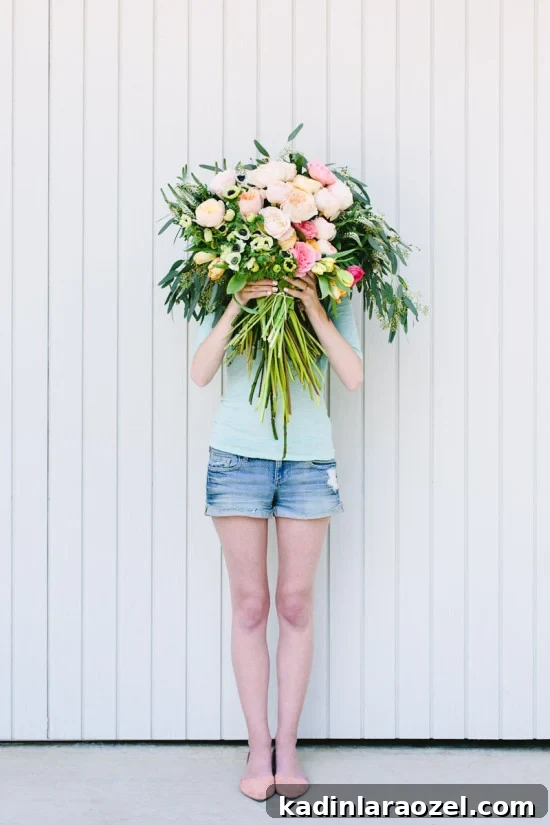
When I work with flowers, I tend to think big. I’ve tackled oversized pieces before, and when the chance came to create something grand again, I didn’t hesitate. The result is a giant DIY bouquet built using a “flower blocking” approach—think color blocking, but with distinct groups of flower varieties instead of colors. The effect is bold and sculptural, almost like an abstract or color-field painting made from blooms.
Large-scale floral projects can be tricky when you don’t have hundreds of stems on hand, so I keep a running list of dream flower DIYs and wait for the right opportunity. Recently, at the Meet/Make/Do event, boxes and boxes of fresh flowers appeared at our doorstep—and I felt like a kid in a candy store.
There was one bloom I was especially excited to work with: the Juliet garden rose (also known as David Austin English garden roses). I researched different arrangements and inspirations to learn how other designers use these lush roses, but I noticed many bouquets featuring them tend to look similar. That’s what inspired the flower-blocked concept: to use garden roses alongside contrasting blocks of other blooms for a different, modern look.
Flowers used in this bouquet:
Light Peach Juliet Garden Roses // Ivory Peach Garden Roses // Keira Pink Garden Roses // Pink Piano Garden Spray Roses // Pink Mayra Garden Roses // White Anemones // Parrot Tulips // White Veronica // Seeded Eucalyptus
Special thanks to Flower Muse for the beautiful flowers provided for Meet/Make/Do.
Additional supplies: scissors // heavy string or twine
How to make a flower-blocked giant bouquet
This technique is best demonstrated with step-by-step photos, but the process is straightforward. Before you begin, recruit a partner to help hold the bouquet as it grows—two pairs of hands make this much easier.
Prepare your flowers: Trim 1/2″ to 1″ off the bottom of each stem at a diagonal to maximize water intake. Remove leaves and excess foliage, then place stems in buckets with 3″–4″ of room-temperature water. Keep flowers in a cool, shaded area until you are ready to assemble.
1. Choose a cohesive visual direction. Decide on a color story or overall vibe—this will guide your choices. Pick the flower varieties you want to feature and make sure they are prepped and hydrated.
2. Build your first block of blooms. Start by grouping 5–7 blooms of the same type and begin layering more of that variety to form a concentrated block. Cross stems under the blooms in an X formation as you add each flower to create structure. I began with a variety of garden roses, adding roughly 20 stems of different garden-rose types and shades to create a dominant center block.
3. Add a contrasting block. Introduce another flower type in a complementary color family to create a second block—around 15–20 white anemones worked well here. I placed them primarily on one side to create a pleasing asymmetry.
4. Fill and refine. Add smaller bunches of secondary elements such as two clusters of white veronica, one on each side of the bouquet. Use parrot tulips to fill gaps lower in the arrangement—their natural curve makes them ideal for the bouquet’s bottom and helps the composition flow.
5. Finish with greenery and secure the stems. Tuck 3–5 full stems of seeded eucalyptus into the back of the bouquet to provide texture and support. Once you’re satisfied with the shape, bind the stems securely with heavy-duty string or twine and trim any excess stems for a clean finish.
The resulting bouquet is dramatic but surprisingly simple to assemble once you understand the block-building method. The look is intentionally organic rather than overly structured, so embrace small irregularities—they add to the visual interest.
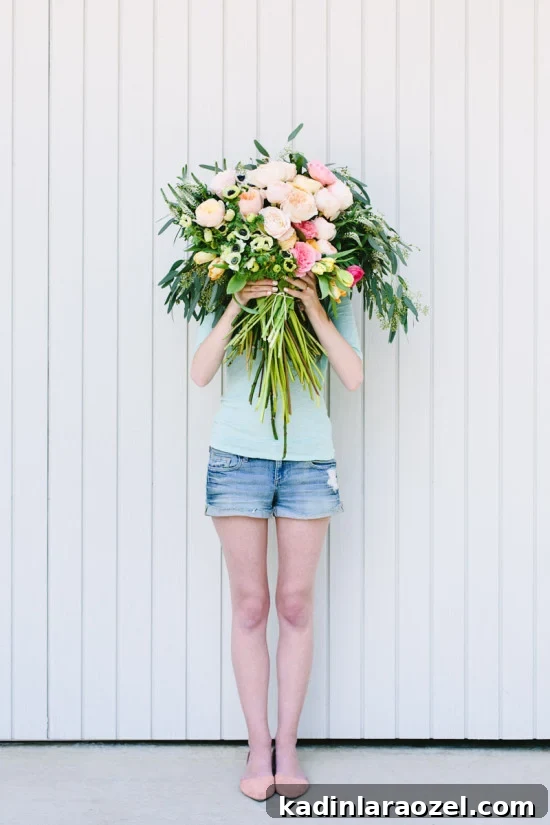
This style is perfect for a statement bridal bouquet or for bridesmaids who want a modern, artful arrangement. If you’re not planning a wedding, you can shorten the stems and place the bouquet in a large vase—though I admit I like the wild, elongated stems for impact.
Photographs by Mary Costa Photography. Concept and styling by Brittni Mehlhoff. Big thanks to Kelly for modeling and serving as my second pair of hands for this project.
This post was sponsored by Bing. All opinions and ideas are my own.