DIY Hanging Wall Organizer for Under $20: Step-by-Step Guide
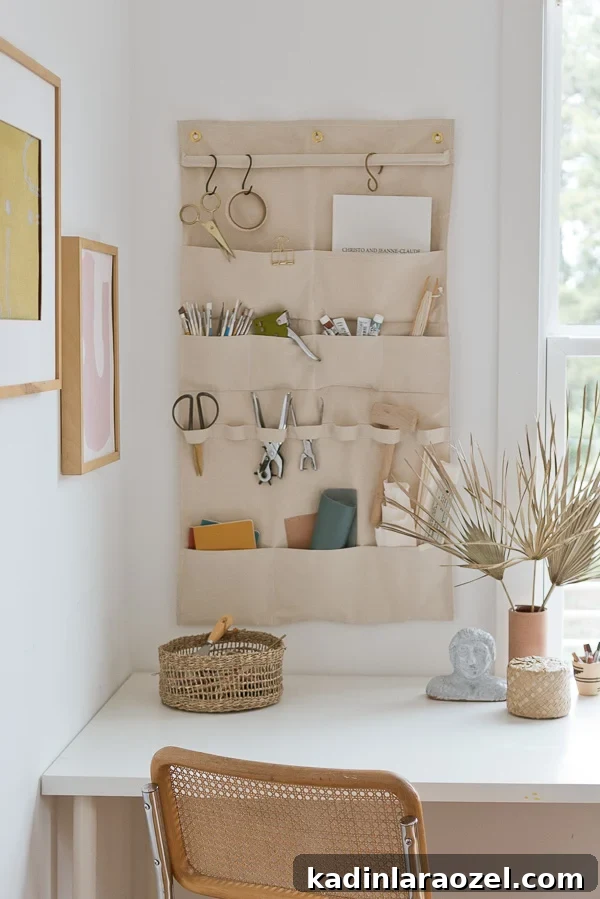
This hanging wall organizer is an ideal way to keep essential items within reach while keeping them neatly out of the way. Best part: you can make it for under $20.
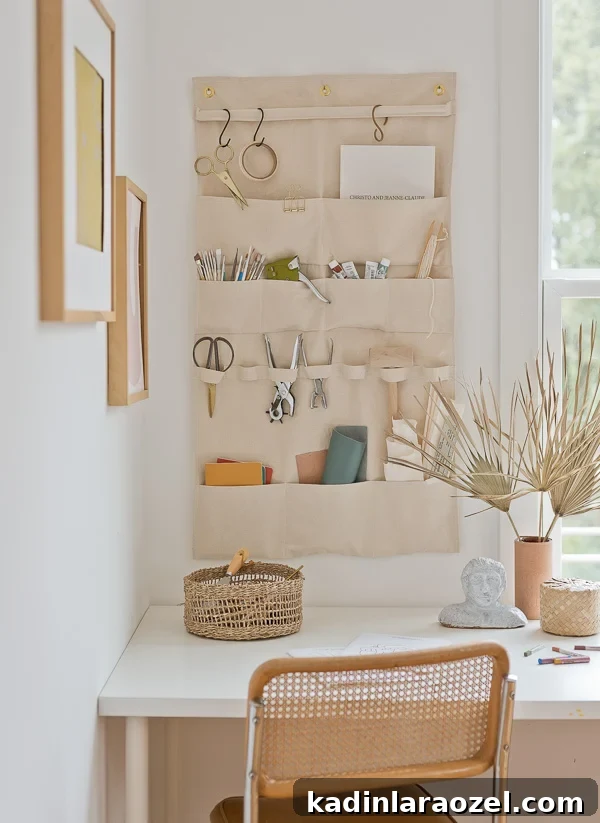
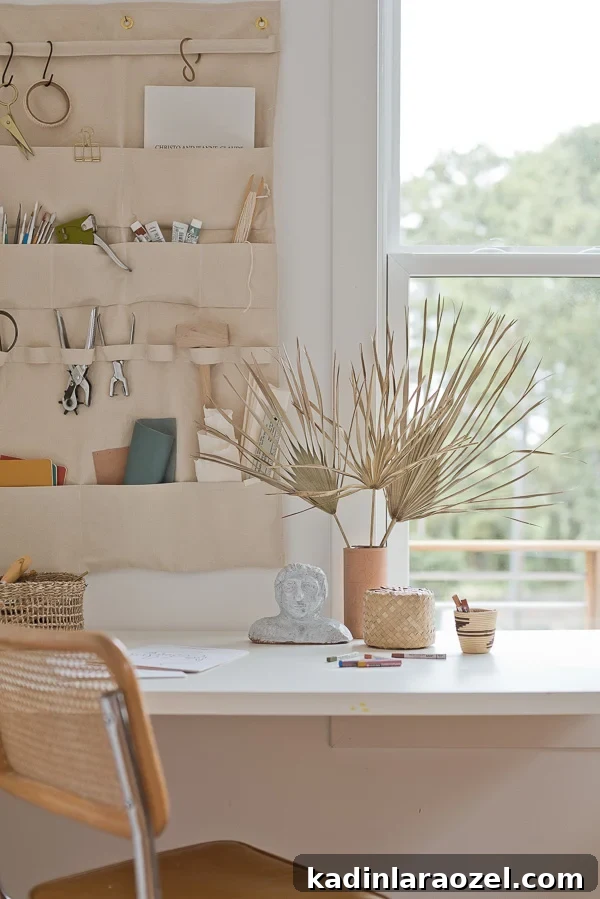
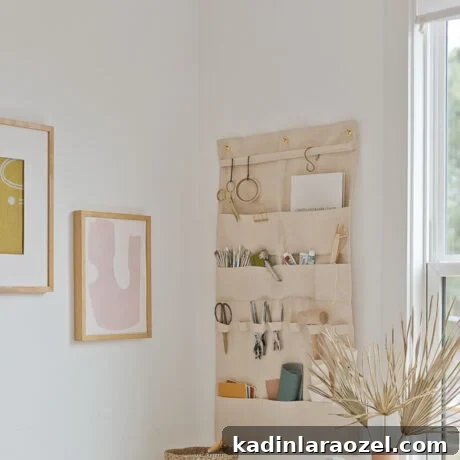
I’d been trying to bring order to my home workspace, balancing a clean aesthetic with real everyday functionality. After brainstorming solutions that were budget-friendly, multi-functional, and visually pleasing, I built this canvas wall pocket organizer. It takes up no floor space, keeps supplies organized, and has been one of the most helpful additions to my office.
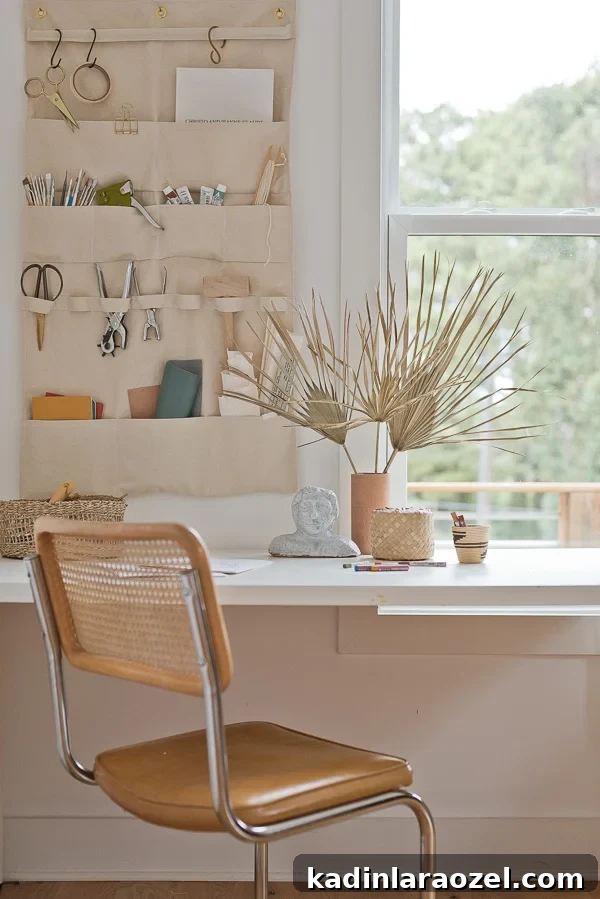
Hanging Wall Organizer DIY
Beyond the clean design and practical layout, the biggest win for me is the cost — you can make this large, sturdy organizer for under $20 if you choose materials carefully. It’s surprising how much storage you can add without sacrificing style or floor space.
What can you use this hanging organizer for?
There are lots of uses. Here are a few ideas:
- Sort incoming mail, bills, and kids’ school papers so they don’t pile up on the desk.
- Store craft and office supplies — this is my preferred use, especially for a work-from-home office that needs to stay clutter-free.
- Hang it in a closet to hold scarves, jewelry, and accessories. You can adapt the design with extra dowels or loops to hang heels or heavier items.
With those uses in mind, here’s how to make one yourself.
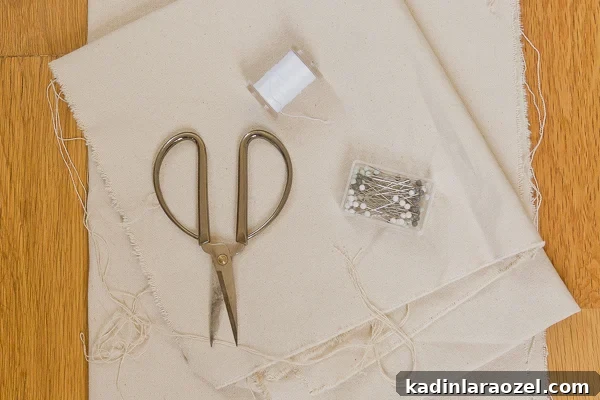
Materials for Hanging Wall Organizer
- 6×9 canvas drop cloth*
- gold grommet kit
- 1/2″ dowel rod, cut to about 22″
- sewing machine
- measuring tape
- pencil or tailor’s chalk
- scissors
- thread
- s-hooks
*A 6×9 drop cloth is a common size; you don’t need exactly this size to recreate the organizer, but it’s a convenient option.
Drop cloth vs. raw artist canvas
Use an inexpensive drop cloth for a practical, utilitarian organizer that will live in a pantry or closet. If the organizer will hang in a visible spot and you want a prettier finish, choose raw canvas from an art supply store. Raw canvas costs more, often significantly so, but it gives a smoother, more refined look.
Whatever you choose, pick a medium or heavy-weight canvas. Thin canvas will be floppy and won’t hold up well when pockets are loaded. Sturdier fabric will keep pockets structured and durable.
Instructions for Hanging Wall Organizer
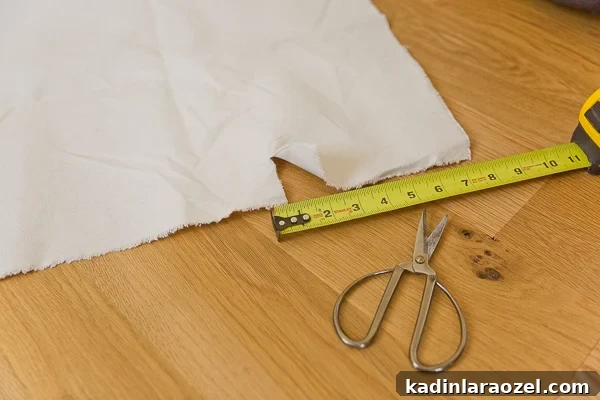
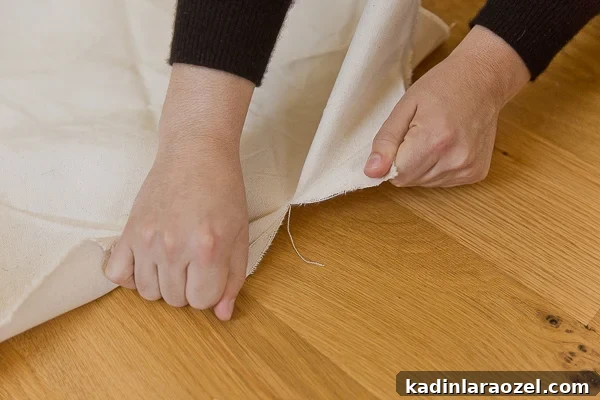
1. Measure and cut these pieces:
- A – 26″ x 48″
- B / C – 7″ x 26″ (two pieces total)
- D – 5″ x 26″
- E – 2″ x 31.5″
- F – 2″ x 26″
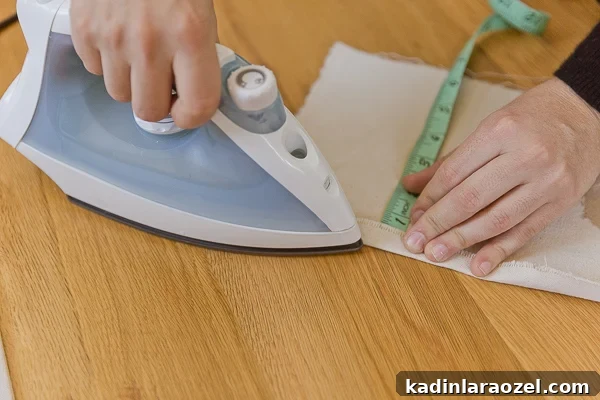
2. Fold the top edges of pocket pieces B, C, and D 1/2″ inward and press with an iron. Topstitch 1/4″ from the folded edge across each pocket.
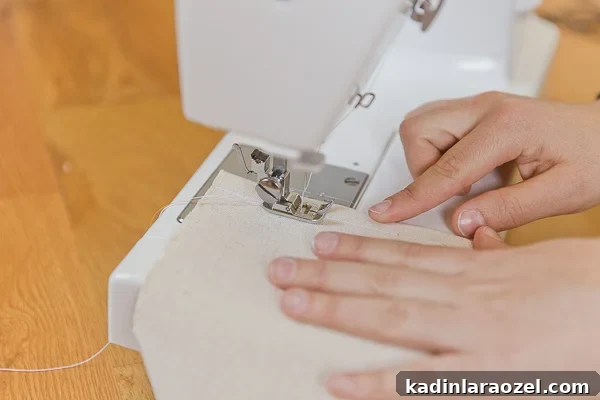
3. Fold both long edges of piece E 1/2″ and press. Sew 1/4″ from each folded edge along the length.
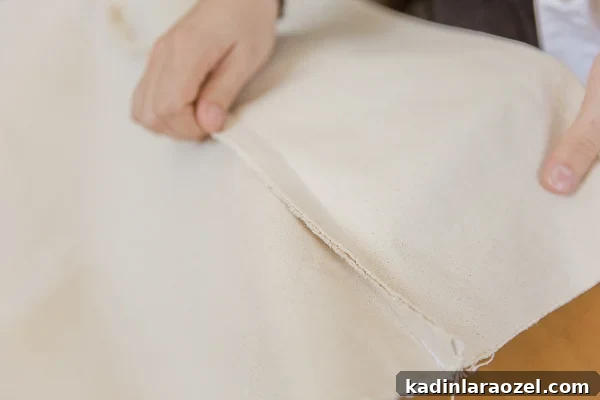
4. Align A and B with their bottom edges together, pin, and sew a 1/2″ seam. Fold the sewn edge upward, press, and pin the sides.
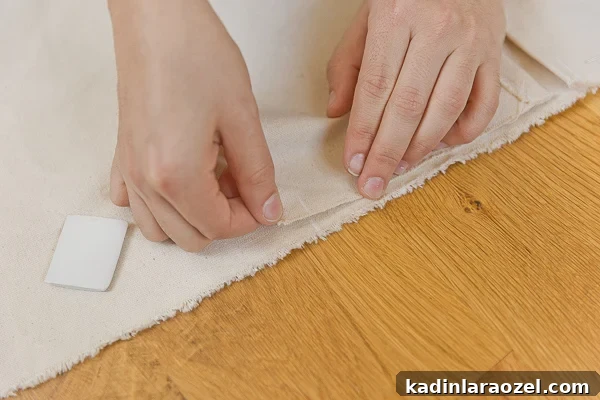
5. From the top of the bottom pocket, measure down 14″ and mark three spots (center and two sides). On piece D, measure 1/2″ up from the bottom and mark the same three spots. Align and pin D so its top meets the marked positions; the exterior of the pocket should face inward so it will show on the outside when flipped up.
6. With D pinned, mark 1/2″ from the pocket edge across the length, then sew along that line to attach D to A.
7. Flip D upward, press, and pin the sides.
8. Two inches above the top of D, align and attach piece C the same way.
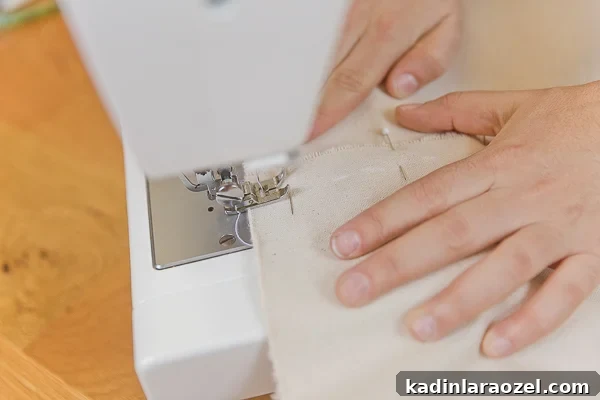
9. Measure 3″ up from the bottom of the center pocket (D) and mark both sides of A. Align the top edge of piece E with that mark, pin E at the edge, then also pin it 2″ in from the edge.
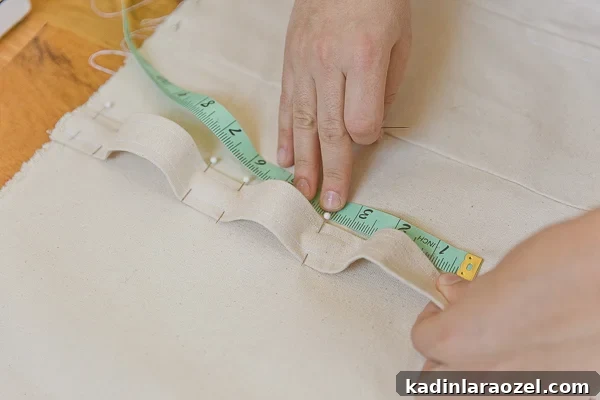
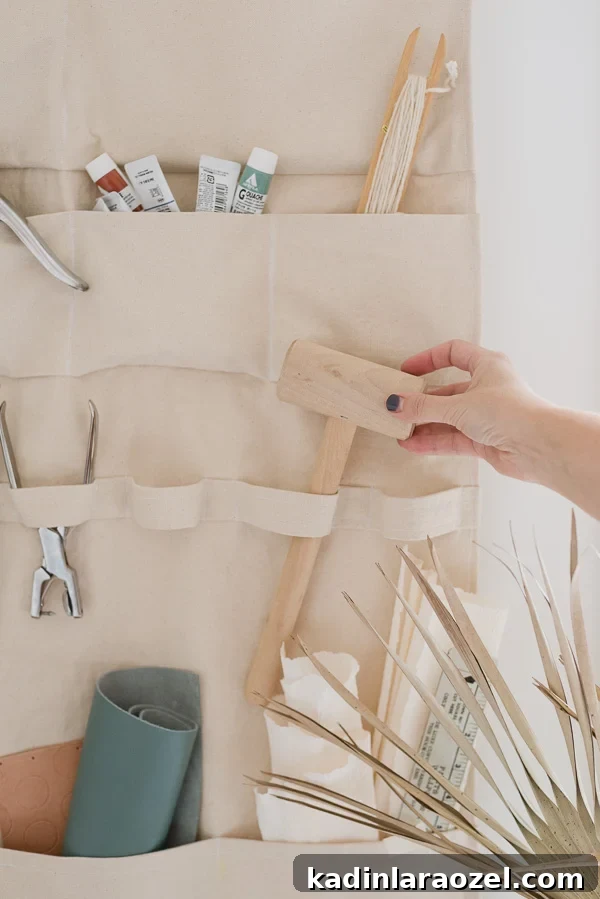
10. Create tool loops using E: for a larger loop (for hammers or large brushes) measure 2.5″ from the 2″ pin and 3″ from the bottom of D on A, and mark. On E, mark 3.5″ from that 2″ pin at the top. Match marks, pin, then add another pin 1″ over to give the loop breathing room. Customize loop sizes to your tools.
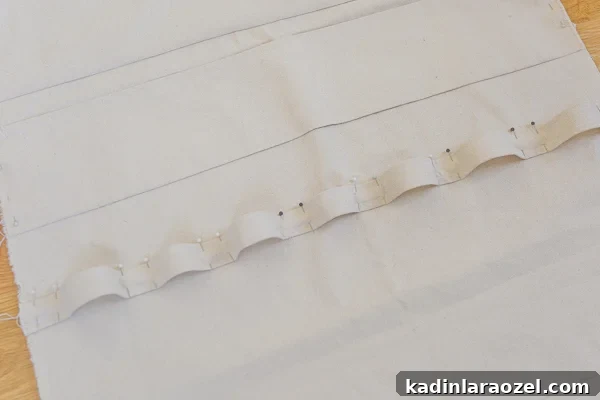
11. For a smaller loop (for scissors, screwdrivers, or wrenches), measure 2″ from the last pin and 3″ from the bottom of D on A, then mark. On E measure 2.5″ from the last pin and mark. Match, pin, and add an additional pin 1″ over.
12. Alternate the two loop sizes so you end with four large loops and three smaller loops — seven loops total. Adjust quantities and spacing to suit your tools.
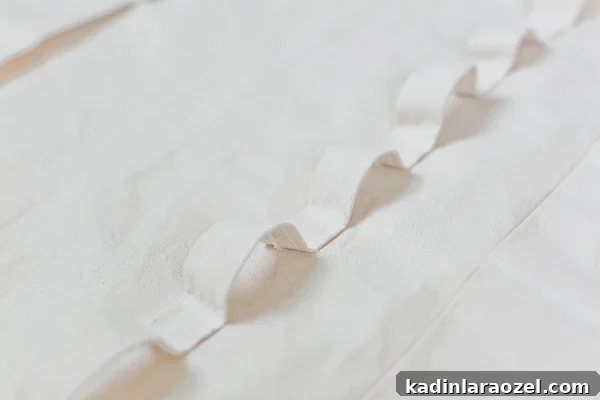
13. Sew vertical seams at each pin (except the two edge pins), creating the loops and internal divisions. Leave the two edge pins for hem finishing.
14. Fold the unfinished short edge of A 1″, press and pin, then topstitch 1/2″ from the fold. Sewing the top edge first makes working around the dowel easier.
15. Make the dowel sleeve: fold piece F 1″ on the top edge and 1/2″ on the bottom edge, press and pin.
16. Test-fit the dowel before final sewing. Trim it to length (about 22″ is the example in this tutorial); you can score the dowel with scissors while spinning it to create a notch and then snap it cleanly. Sand or trim any splinters.
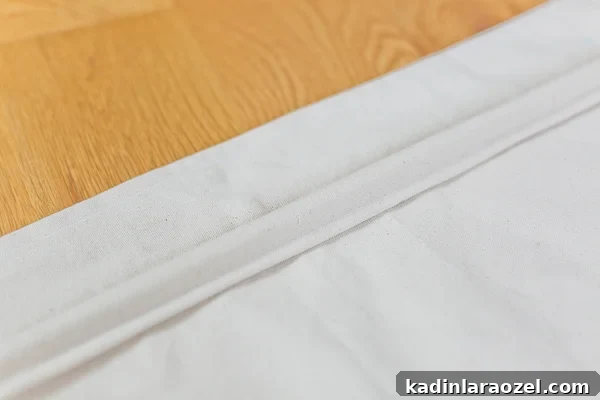
17. Sew F along the 1/2″ side using a 3/8″ seam, slide the dowel inside, and set aside.
18. Mark 3″ in from each unfinished side at the top of A with tailor’s chalk. Align the finished F sleeve (dowel inside) with those marks, dowel pointing upward, and pin in place.
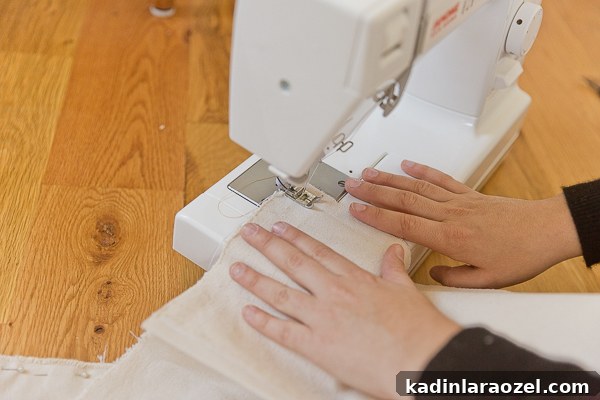
19. Fold each side of A in 1″, pin, and sew the edges to encase the sleeve and finish the sides. Expect a bulky seam — sew slowly and adjust your machine tension if necessary.
20. Sew pocket B (the bottom pocket) into three sections by marking at 8″ and 16″ and stitching vertical lines at those marks.
21. Divide pocket D into four sections by marking at 6″, 12″, and 18″, then sewing those lines.
22. Sew pocket C in half by marking the center at 12″ and topstitching down the center line.
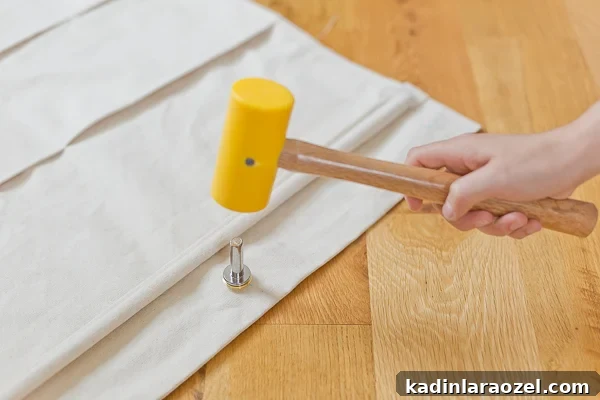
23. Add grommets along the top for hanging. I recommend three grommets for balanced support. Mark the center of the organizer, then measure 2″ down from the top at the center and cut a small X for the grommet hole. Repeat for marks 2″ in from each side and 2″ down from the top for the left and right grommets.
24. Install the grommets following the kit instructions.
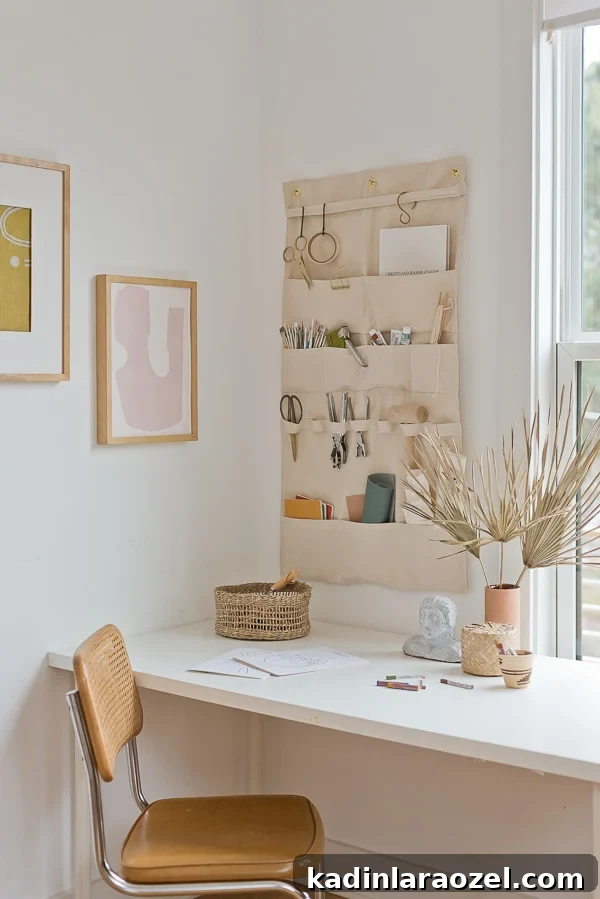
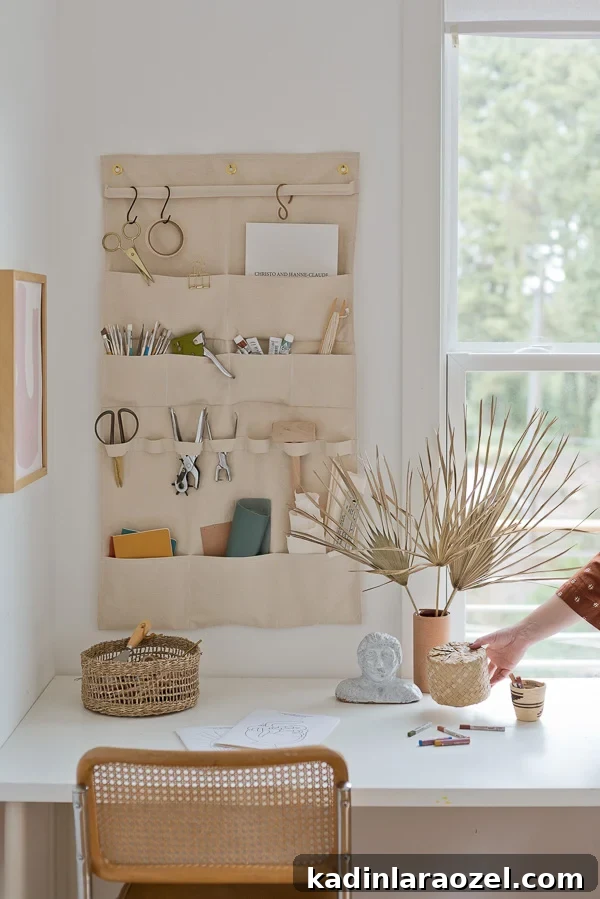
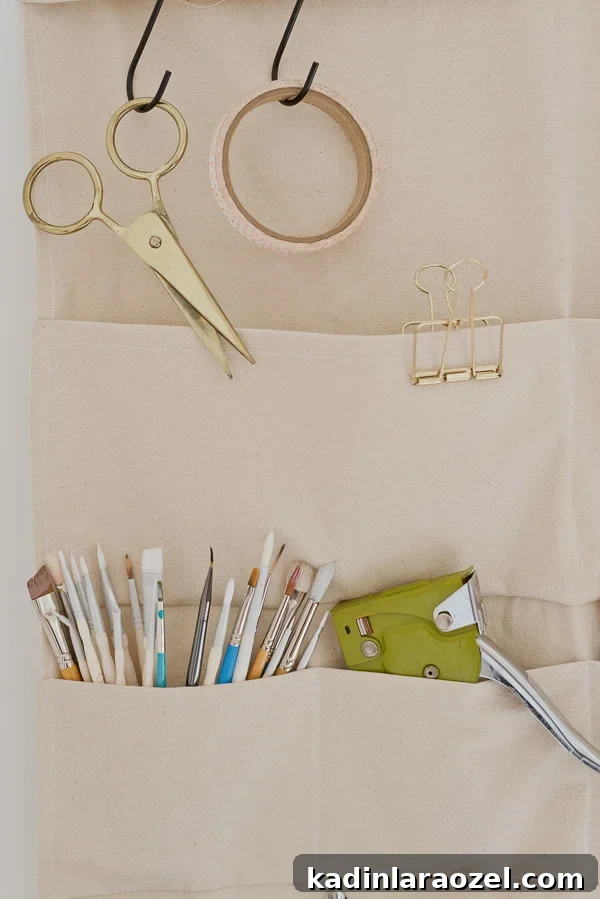
25. Hang your organizer and load it with supplies. Use s-hooks on the dowel to hang scissors, tape, clamps, or keys. The arrangement is flexible — adapt pockets and loops for whatever you need to store.
Hanging Wall Organizer DIY
Ingredients
- 6×9 canvas drop cloth
- gold grommet kit
- 1/2″ dowel rod, cut to ~22″
- sewing machine
- measuring tape
- pencil or tailor’s chalk
- scissors
- thread
- s-hooks
Instructions
Measure and cut the following pieces:
- A – 26″ x 48″
- B / C – 7″ x 26″ (two pieces)
- D – 5″ x 26″
- E – 2″ x 31.5″
- F – 2″ x 26″
Fold tops of pockets (B, C, D) 1/2″, press, and topstitch 1/4″ from the top.
Fold E’s edges 1/2″, press, and sew 1/4″ from each edge.
Attach B to A along the bottom, sew a 1/2″ seam, fold up, press, and pin sides.
Attach D and C in sequence, marking and aligning as described, then topstitch 1/2″ from the edges to secure.
Position E to create loops and tool holders. Customize loop sizes; alternate larger and smaller loops for a total of seven loops.
Sew vertical seams for loops and pocket divisions, leaving the outermost edge pins for hem finishing.
Finish the top edge and prepare the dowel sleeve using F, test-fit and trim the dowel to length, insert it into the sleeve, and pin the sleeve in place.
Fold A’s side hems, pin and sew. Sew pocket divisions for B, D, and C to create the desired compartments.
Add three grommets across the top (center and two sides) by cutting small X-shaped holes and following the grommet kit instructions.
Hang the organizer, add s-hooks to the dowel, and fill the pockets with supplies. Adjust pockets, loops, and hanging hardware to suit your needs.
Sewing by Casey Harper
Photography by Amelia Lawrence
Thinking of making this hanging wall organizer? Consider how you’ll use it: bills and mail, craft supplies, tools, or accessories. The flexible design makes it easy to adapt pockets and loops to your needs.
More organizing DIY ideas
- Wood peg rail organizers are great for entryways and workspaces.
- Simple wall hooks can tidy coats, bags, or hats.
- A bathroom organizer with a mirror can add functional storage to small spaces.